
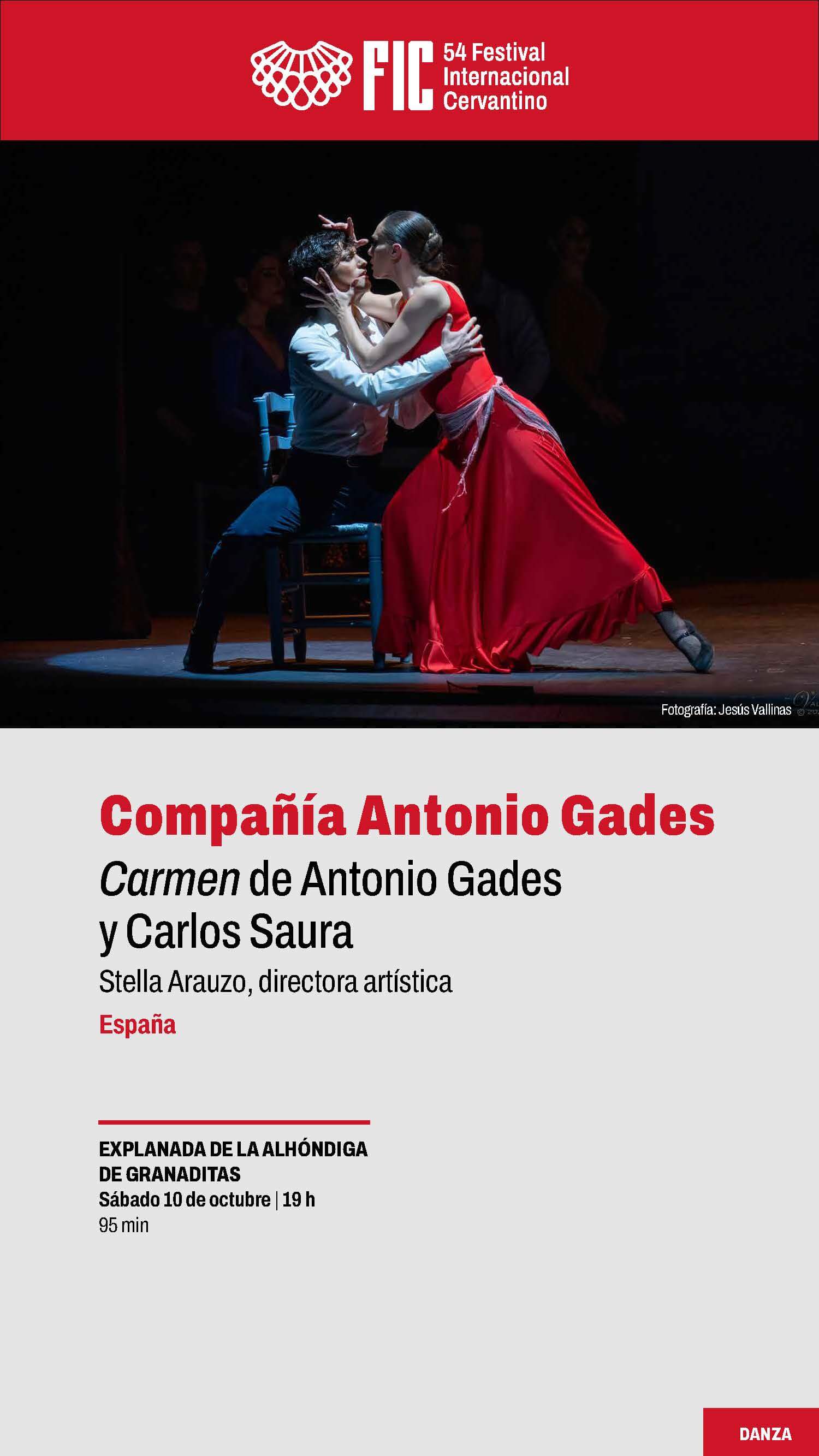
Compañía Antonio Gades
Carmen by Antonio Gades and Carlos Saura


For Antonio Gades, Carmen embodies a woman’s struggle for freedom in the face of social conventions. When the work was conceived in 1837, it caused a scandal in an era that could not even begin to envisage women’s emancipation. With this in mind, Gades and the filmmaker Carlos Saura reclaimed the myth of the ‘foreign gaze’ to restore its true Spanish identity, moving away from stereotypes and portraying a woman who gives herself unreservedly, yet never betrays her true nature.
The clarity with which the story is told is an unmistakable hallmark of Gades. The transitions between scenes offer cinematic nods bearing Saura’s signature, helping the audience move from one emotion to another in a dizzying yet organic manner. Today, in contrast to the quintessential Spanish male myth, Don Juan, Carmen represents Spanish women on the world stage. This piece is a manifesto of sovereignty by the Antonio Gades Company, in which dance becomes the cry for a necessary liberation.
Following the death of Antonio Gades, his widow, Eugenia Eiriz; his daughter, María Esteve; and his dance partner, Stella Arauzo, joined forces to preserve a legacy that lives on at the very highest levels of European stage dance.
Profiles


Jesús Vallinas
Alberto Rodrigálvarez
Jesús Vallinas
Compañía Antonio Gades
Carmen by Antonio Gades and Carlos Saura
* No aplica ningún tipo de descuento
Free access to the bleacher seating area
Sala Principal del Teatro Bicentenario
Instituto Nacional de Bellas Artes y Literatura
Sala Principal del Palacio de Bellas Artes
* Programme subject to change


